My mom was not much of a baker. At our house, all cookies were chocolate chip (from the recipe on the bag of chips) or spritz cookies at holidaytime. Her cakes were from boxed mixes. (She called them “stupid cakes” because “any stupid fool can make one.”) That was pretty much her dessert repertoire. Mom did have one dessert that always wowed the crowd, Roulage Léontine, from Dione Lucas’s 1964 classic, The Gourmet Cooking School Cookbook. While I’ve updated the recipe and called it Chocolate Roulade, in my heart this is still the 1960’s-era dessert that my mom made when she really wanted to impress her dinner guests.
The cookbook is organized as a set of menus. The roulage or roulade ( a more modern term) is part of Menu 27, which starts with an Omelette aux Fines Herbes, moves onto Poulet Majorca and Pommes de Terres Sauteé, and finishes with the roulage/roulade. The recommended wine for the meal was Portugese Lancers. Quite a throwback to be sure.
Paging through the book, I’m transported back to the days of Julia Child and the American fascination with classical Continental cuisine. In the intervening decades, Julia became an icon and Dione faded from our collective culinary consciousness. Still, I keep coming back to Dione and her roulage/roulade.
Note that this recipe isn’t for everyone. Chocolate Roulade is a bit complicated and requires bravery, especially for the part when you flip the fallen chocolate soufflé over. Still, if you have the time, patience, and skill to make this dessert, you’ll be happy with the results and so will everyone you serve it to.
I’ve toned the recipe’s sweetness down, switching from sweet dark chocolate to a combination of bittersweet and semi-sweet. Also, I moved from a fairly sweet vanilla whipped cream to a mocha or other flavored filling. Still, it continues to be a glorious, flourless (gluten-free) fallen chocolate soufflé filled with whipped cream.
Tips for Making Chocolate Roulade


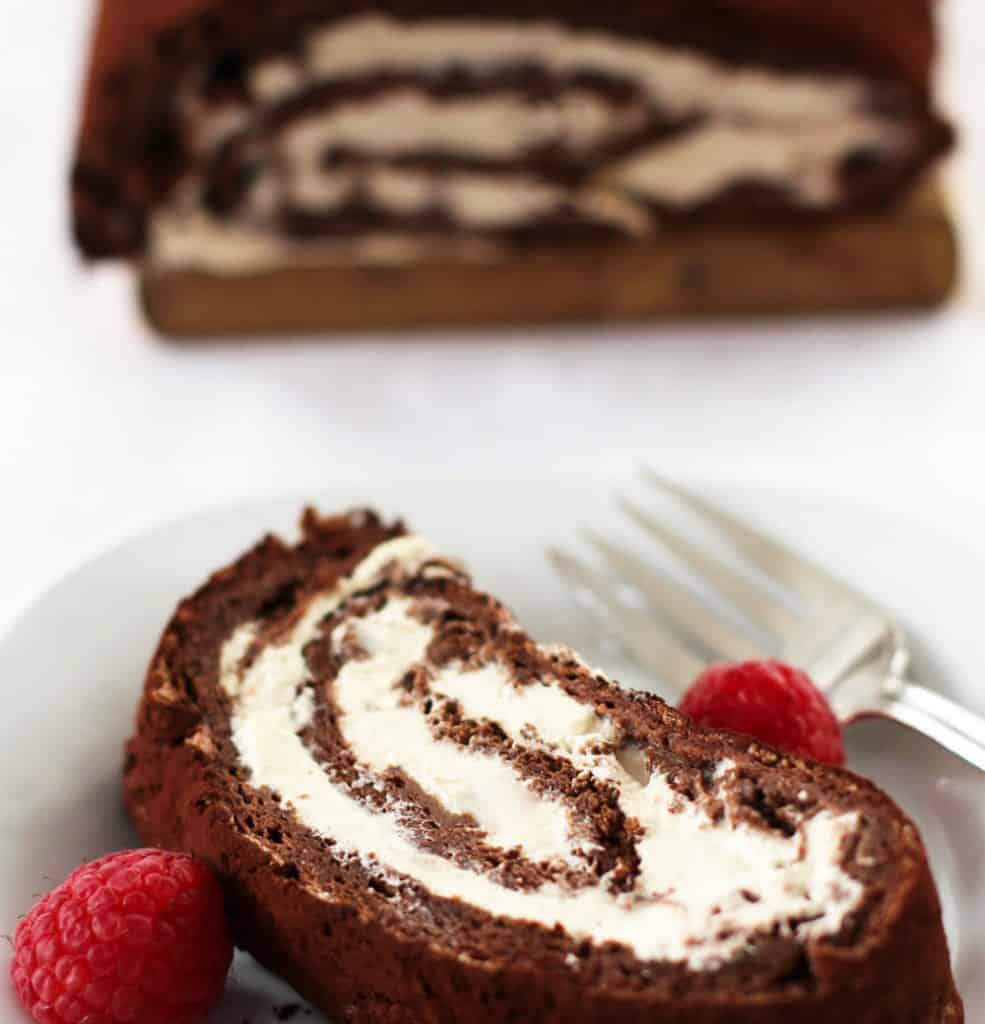
- Be Organized. Mise en place (or everything in its place – setting out your ingredients beforehand and keeping the next step in mind as you move along) takes on new meaning when you are working with what is essentially a fallen chocolate soufflé.
- The Temperature of the Eggs Matters. Start with cold eggs. They are easier to separate than room temperature ones. However, the warmer egg whites whip up better. So separate the eggs soon after taking them out of the refrigerator. Let the whites warm up while you work with the yolks and chocolate. When you separate each egg, let the white drip into a small container. Do not allow any yolk to get into the white. Pour that white into the larger bowl of whites. (Even a drop of yolk in the whites will prevent them from whipping.)
- Don’t Overbeat the Eggs or Cream. Be gentle as you whip the egg whites and cream. An extra minute of beating “just to be sure” can decimate fluffy egg whites or turn whipped cream into butter. The same goes for folding the egg whites and the chocolate. A few soft sweeps that melds the two almost-but-not-completely is better than a vigorous mixing that deflates the air you have so carefully whipped into the egg whites.
- Keep track of time. The chocolate soufflé should not be over-baked and needs the specified resting time (under paper towels) to remain moist for rolling. These steps take less than 45 minutes, but are essential. My latest effort was less than perfect. Sure a crack in the top of the roll would be a point against you on The Great British Baking Show. However, I’m just a home baker doing my best.
- Be Brave. Flipping the chocolate roll over and rolling it is not for the faint of heart. Be brave and go for it!
- Tinker with the Filling. As long as you keep the cream stiff but spreadable, you can change up the taste of the filling. It can be “plain” vanilla, mocha, orange flavored (with fiori di sicilia if you want), or any other flavoring that suits you. Channel Dorie Greenspan and bring all your baking creativity to this game. Matcha anyone?
Chocolate Roulade
A fabulous showstopper dessert that consists of a chocolate roll and flavored whipped cream.
Ingredients
Chocolate Roll
- 8 eggs
- 4 ounces bittersweet chocolate finely chopped
- 4 ounces semi sweet chocolate finely chopped
- 1/3 cup cold water
- 1 cup superfine sugar or regular sugar spun in a food processor
- pinch of kosher or fine sea salt
- 2-3 tablespoons baking/unsweetened cocoa not drinking cocoa
Filling
- 1 cup + 2 tablespoons heavy cream or whipping cream
- 2 tablespoons of light brown sugar
- 1-2 tablespoons confectioners or superfine sugar
- 1/2 teaspoon vanilla or if using orange 1/4 teaspoon vanilla & 1/4 teaspoon fiori di sicilia
- 1 1/2 teaspoons espresso powder not espresso crystals or orange rind & a dash of orange oil (latter optional)
- 1/2 teaspoon hot water or if using orange hot orange juice
Instructions
Chocolate Roll
-
Oil a half-sheet pan and cover it with a long sheet of wax paper. Let the edges of the paper extend 1/2-1 inch or .8-1.6 centimeters beyond the shorter ends of the pan. (Leave the wax paper unoiled.)
-
Pre-heat the oven to 350°.F/180°C.
-
Separate the 8 eggs, putting the yolks in a medium-large bowl and the whites in a large bowl.
-
Put the chopped chocolate and the cold water in a small, heavy pot and melt the chocolate under a low light, stirring frequently with a wooden spoon or a silicone spatula for approximately 4-5 minutes until the mixture is thick and smooth. Set it aside to cool.
-
Add the superfine (or ground white sugar) to the yolks and beat the mixture for several minutes until they are light and fluffy. Set it aside.
-
Once the chocolate has cooled, add it to the egg yolk and sugar mixture, and gently fold them together. Set that mixture aside.
-
Beat the egg whites. After about 2 minutes (with a mixer), as they get foamy, add the pinch of salt. Keep beating only until the whites form soft peaks, about 6-7 minutes on medium speed.
-
Gently fold the chocolate/egg/sugar mixture into the egg whites, using a spatula. Once the mixture is a reasonably uniform, light brown color, pour it onto the wax paper-lined cookie sheet. Smooth the batter out and bake it for 17 minutes.
-
While the soufflé is baking, lay out two overlapping pieces of wax paper the size of the pan on a table with the one closest to you on top.
-
Once the soufflé is done, put it on a counter and immediately cover the top with 2 layers of paper towels well-sprinkled with cold water and gently wrung out, plus a top layer of dry paper towel. Leave the paper towels on top for 20 minutes, then gently remove them.
-
With a small, sharp knife, gently cut the side edges of the fallen soufflé away from the pan and try to lift them to make sure the cut has released the fallen soufflé. Using a small strainer and a spoon, dust the entire top of the soufflé with cocoa, completely covering the area.
-
Pick up the pan and without hesitation, flip it over onto the wax paper laid out on the table, hopefully somewhere near the center of the long strip and with the long edges of the souffle aligned with the long edges of the wax paper. Phew! It's now on the table with the wax paper it baked on now on top.
-
Gently lift off the covering wax paper (it’s a bit oily on the side now facing up.) You may have to use the sharp knife to release the souffle from the paper in places. If a bit sticks to the wax paper, you can skim it off and place it on the souffle – this will be the inside of the cake and it won’t show once you roll it up.
Filling
-
Mix the brown sugar, 1 tablespoon of the confectioners or superfine sugar, the vanilla & optional fiord di sicilia, espresso powder or orange rind/oil and water or orange juice. Mix them into a smooth or almost-smooth paste.
-
Whip the cream until it has soft peaks (about 5 minutes on medium speed with a mixer) and then add the paste. Continue whipping for another 2 minutes or so. the cream should still be soft, but also hold its shape.
-
Put heaping spoonfuls of the filling over the soufflé, leaving about an inch or a bit more at the end nearest you. Gently smooth out the filling, then roll the soufflé towards you, using the wax paper farthest from you to pull the roll over on itself and toward you.

Leave a Reply